Field notes/Product Page & CRO
Fake Abandoned Checkouts on Shopify: When Bot Carts Make Conversion Data Unusable
Fake abandoned checkouts can make Shopify funnel data look worse than the buying journey really is. Diagnose bot noise before changing offers, ads, recovery emails, or checkout UX.
When Shopify abandoned checkouts spike because of bots or card-testing activity, the problem is data quality first and CRO second. Cleanly separate fake checkouts from real buyer hesitation before changing discounts, recovery emails, paid traffic, or the cart experience.
What are fake abandoned checkouts on Shopify?
Fake abandoned checkouts on Shopify are checkout or cart records created by automated traffic rather than real shoppers. They often appear during bot attacks, card-testing attempts, spam customer creation, or scripted checkout abuse. The visible symptom is a sudden rise in abandoned checkouts, low-quality emails, strange addresses, repeated names, suspicious geographies, or carts that never behave like normal buyers. The business risk is not only fraud. Fake checkout records can distort conversion rate, bury real abandoned carts, trigger recovery emails to bots, damage deliverability, and make teams change ads or checkout UX based on polluted data. Treat the issue as a data-quality triage first, then audit the buyer path once the fake traffic is separated.
Key takeaways
- Fake abandoned checkouts can pollute Shopify analytics, email automations, and funnel diagnosis.
- Start with revenue truth, checkout records, traffic patterns, and email engagement before changing CRO tactics.
- Bot carts and real cart abandonment need separate segments, separate reporting, and separate fixes.
- If clean human sessions still leak after filtering bot noise, then audit product-page, cart, checkout, trust, and shipping friction.
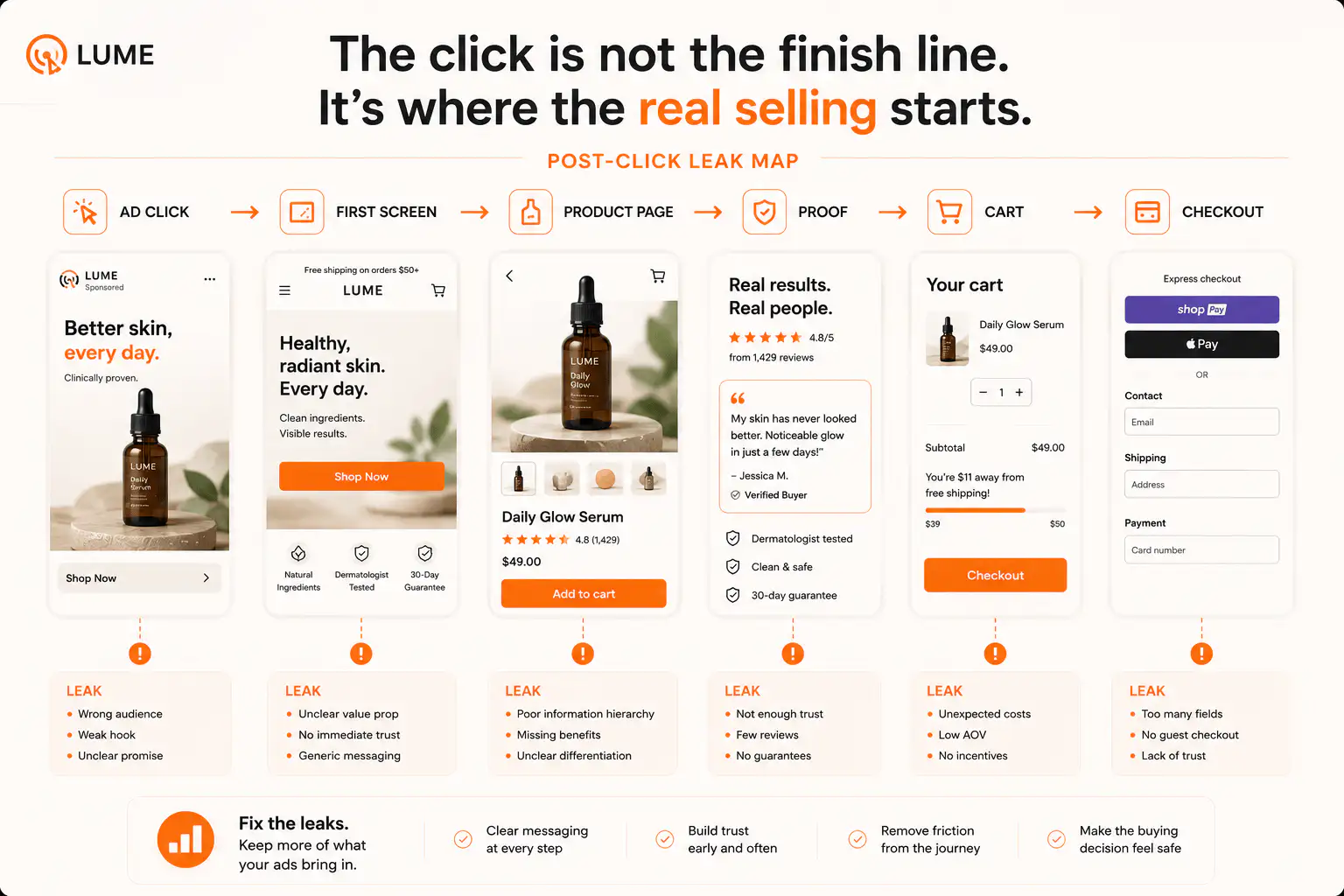
A spike in abandoned checkouts looks like a conversion problem until you inspect the records. The store may still receive normal orders, but Shopify suddenly shows hundreds of checkout starts, fake customers, repeated addresses, low-value products, or abandoned carts that never came from a believable shopping path.
If the team reads that spike as normal buyer hesitation, the next actions are usually wrong. They add discounts, rewrite abandoned-cart emails, blame checkout, pause ads, or redesign cart UX. None of those fixes help if the funnel is being filled by automation.
How do fake abandoned checkouts usually show up?
The clearest sign is a pattern that does not look like human shopping. Real buyers vary. Bot records repeat. In Shopify Community threads, merchants described waves of similar names, numeric email patterns, low-priced products added repeatedly, fake customer accounts, and checkout records that made abandoned-checkout data unusable.
- A sudden abandoned-checkout spike without a matching traffic campaign.
- Many customer records with similar name, email, address, or country patterns.
- Checkout attempts on very low-priced products or accessories.
- Large abandoned-checkout volume with no meaningful product browsing.
- Recovery emails sent to addresses that never open, click, or buy.
- Card-testing symptoms such as many failed payment attempts or suspicious payment behavior.
- Conversion rate dropping while real order count stays roughly stable.
Do not merge fake abandoned checkouts into the same diagnosis as normal cart abandonment. Bot noise is a data-quality problem. Real abandonment is a buyer-confidence problem. They can happen at the same time, but they should not be measured as one problem.
What should you verify before changing the buying path?
Start with the numbers closest to money received. Shopify orders, captured payments, refunds, and fulfilled products tell you whether real revenue changed. Abandoned checkouts are useful only after you know whether the records represent real shoppers.
| Signal | Likely meaning | First check |
|---|---|---|
| Orders steady, abandoned checkouts spike | Bot or tracking contamination likely | Inspect checkout/customer patterns |
| Orders down, sessions steady, ATC down | Possible real PDP or traffic issue | Audit landing pages and product clarity |
| Checkout starts up, email opens down | Bot records polluting recovery list | Segment checkout records by engagement |
| Failed payments spike | Possible card testing | Review payment risk and checkout records |
| Same address or email pattern repeats | Automation likely | Bucket and exclude those records |
| Only one source or country spikes | Traffic-quality or bot-source issue | Compare source, geography, device, and behavior |
How should you separate bot carts from real abandoned carts?
Create a working bot segment before judging the funnel. The segment does not need to be perfect on day one. It needs to be good enough to stop fake records from driving CRO decisions.
- Export or inspect recent abandoned checkouts during the spike window.
- Group records by email pattern, customer name pattern, address, country, product, order value, and time interval.
- Compare checkout records against product-page views and cart behavior when those events are available.
- Separate records that have no email engagement, no normal browsing, no purchase history, and repeated suspicious attributes.
- Suppress likely-bot records from abandoned-checkout automations where your email tool allows it.
- Build a clean human segment for CRO analysis and compare it against the polluted default report.
- Document the filters used so future teams know why reported abandonment changed.
A Shopify Community merchant described separating abandoned cart and abandoned checkout automations, then filtering contacts that had no email engagement, no order, and no meaningful site visits outside checkout. That kind of filter is not a universal rule, but it shows the right logic: preserve recoverable human intent while isolating obvious automation.
When is it card testing instead of ordinary bot traffic?
Card testing means automated actors use checkout or payment attempts to test stolen card data. It can create fake customers, failed payment attempts, and abandoned checkouts. Treat it as a security and payment-risk issue, not a normal conversion leak.
- Many checkout attempts repeat in a short time window.
- The attempts target low-priced products that reduce payment friction.
- Failed payment attempts increase without a matching increase in real orders.
- Customer details look disposable or patterned.
- Recovery emails and abandoned-checkout reports become unusable.
- Staff spend time manually sorting records that should not be in the buyer funnel.
Shopify's bot-protection documentation distinguishes general bot handling from extra Plus checkout protection for limited, scheduled events. That matters because not every store can solve checkout-stage automation from the theme layer or a storefront app. Some mitigation may require Shopify settings, payment/fraud controls, app-level filtering, or upstream traffic controls.
What can you do without paid external APIs?
You can do useful triage with Shopify admin, Shopify analytics, GA4, your email platform, payment records, and security tools you already use. The goal is not to perfectly identify every bot. The goal is to stop obvious fake records from driving buyer-path decisions.
| Layer | Free or existing check | What it tells you |
|---|---|---|
| Shopify orders | Compare order count and revenue before/after spike | Whether real revenue changed |
| Shopify abandoned checkouts | Inspect repeated names, addresses, products, times | Whether records look automated |
| Shopify analytics | Use available human/bot or traffic-pattern dimensions where present | Whether sessions include suspicious patterns |
| GA4 | Check geography, device, source, engagement time | Whether traffic behaves like shoppers |
| Email platform | Compare opens, clicks, orders, bot-like contacts | Whether recovery audience is real |
| Payment admin | Review failed payments and risk patterns | Whether card testing is likely |
Should you turn off abandoned checkout emails?
Do not turn them off permanently just because bots polluted the list. First split the problem. If bots are triggering checkout records and harming deliverability, pause or suppress the polluted flow while you build a cleaner segment. Keep human cart recovery alive where you can.
A clean recovery setup should use behavior and outcome rules, not only the existence of an abandoned checkout. A real buyer often viewed products, added to cart through the storefront, opened previous emails, used a normal address, or returned later. Bot records often cluster around repeated attributes and zero engagement.
If abandoned checkout email performance collapsed during a bot spike, the email may not be bad. The recipient pool may be polluted. Fix the audience before rewriting the sequence.
When should CRO work start again?
CRO work starts after you have a clean enough view of human behavior. If filtered human sessions still reach cart and leave, then diagnose the normal buyer path: product clarity, offer match, cart reassurance, shipping cost, delivery timing, payment trust, discount behavior, and mobile checkout friction.
| Clean human symptom | Likely CRO area | What to inspect |
|---|---|---|
| Product views high, add-to-cart low | PDP clarity | First screen, proof, options, CTA |
| Add-to-cart high, checkout start low | Cart confidence | Shipping, discount, cart drawer/page |
| Checkout start high, purchase low | Checkout/payment trust | Payment options, delivery, total cost |
| Mobile leaks more than desktop | Mobile buying path | Sticky CTA, variants, page order |
| Paid traffic leaks more than organic | Message match | Ad promise, landing path, offer proof |
| Recovery emails ignored by clean users | Unresolved hesitation | Cart reason, email promise, incentive logic |
What should not be changed during a bot spike?
Avoid changing the offer, checkout layout, recovery discount, or ad budget based only on polluted abandonment metrics. A bot spike can make the store appear weaker than it is. If real orders and clean human sessions are stable, the priority is data cleanup and mitigation.
- Do not raise discounts because fake checkouts did not recover.
- Do not blame product pricing until clean human checkout behavior supports it.
- Do not judge abandoned-cart email quality from bot recipients.
- Do not redesign checkout because fake records entered checkout.
- Do not scale or pause campaigns until traffic-source quality is separated from bot noise.
- Do not use raw abandoned checkout count as a KPI during the attack window.
How should you document the cleanup?
Create a short incident note. Include the start date, visible pattern, affected products, suspicious attributes, raw abandoned checkout count, estimated bot segment, clean human segment, revenue impact, email impact, and any mitigation steps. This makes future reporting readable.
Then build a new baseline after the spike is filtered. Compare clean human sessions, add-to-carts, checkout starts, orders, revenue, and recovery-email performance against that baseline. The baseline matters more than the polluted chart.
Need bot noise separated from real buyer leaks?
If abandoned checkouts, bot carts, or fake customers made your Shopify funnel unreadable, get a Store Autopsy. We will separate data pollution from product-page, cart, checkout, and traffic leaks before you change the wrong thing.
FAQ
Are fake abandoned checkouts a Shopify CRO problem?
They are a data-quality and security triage problem first. Once fake checkouts are segmented out, the remaining human buyer behavior can be audited for real CRO issues such as product-page doubt, cart friction, shipping surprise, or checkout hesitation.
How can I tell if abandoned checkouts are bots?
Look for repeated names, disposable-looking emails, repeated addresses, strange geographies, low-priced products, high-frequency attempts, no normal browsing path, no email engagement, and no real orders. One signal is not enough; patterns across several fields are more useful.
Should I delete fake abandoned checkouts from Shopify?
Shopify may not expose a simple deletion path for abandoned checkout records, and transactional records can be difficult to remove for audit reasons. A practical workflow is to segment, tag, suppress, and exclude obvious bot records from reporting and recovery decisions.
Can abandoned checkout bots hurt email marketing?
Yes. If recovery emails are sent to fake or low-quality addresses, open and click rates can collapse and deliverability can suffer. Suppress likely-bot segments before rewriting the abandoned checkout sequence.
When should I audit the cart and checkout UX?
Audit UX after bot noise is filtered. If clean human shoppers still leave between cart, checkout, and purchase, inspect shipping clarity, delivery timing, discount behavior, payment trust, cart layout, and mobile friction.
Sources and verification notes
- Shopify Help, protecting your store from bots, retrieved 2026-07-20
- Shopify Help, bot protection for checkout events, retrieved 2026-07-20
- Shopify, Bot Traffic Detection guide, retrieved 2026-07-20
- Cloudflare Docs, bot solutions overview, retrieved 2026-07-20
- Shopify Community, card testing bot attack discussion, retrieved 2026-07-20
- Shopify Community, bots creating and abandoning carts discussion, retrieved 2026-07-20
- Reddit r/shopify, merchant discussion on fake carts and bot visits, retrieved 2026-07-20