Thankik/Services/Ecommerce CRO
Find and fix post-click leaks before buying more traffic.
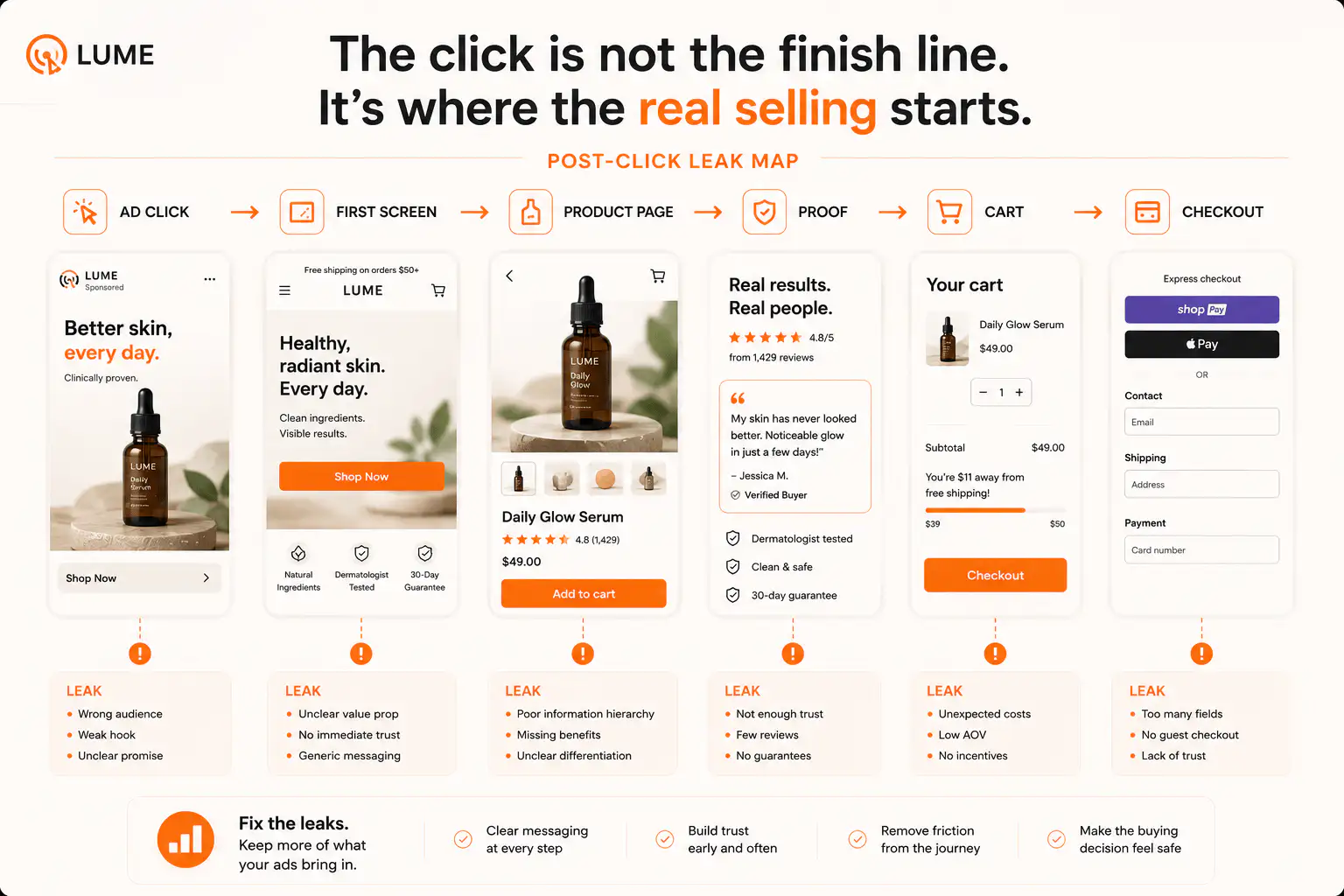
We look at what happens after the click: whether the page matches intent, explains the offer, earns belief, handles risk, and makes the next step easy.
2-minute quiz · your first look by email in a few minutes · no call needed
S1The problem
More traffic magnifies weak post-click journeys.
If the store does not explain the product, prove the promise, reduce risk, or keep mobile buyers moving, increased spend usually makes the leak more expensive.
S2Scope
What we rebuild for Ecommerce CRO.
- 1
Offer clarity
Check whether the page quickly explains what the product is, who it is for, why it matters, and what makes the offer compelling.
- 2
PDP proof
Identify missing or badly placed reviews, results, demos, comparisons, specifications, and trust cues.
- 3
Trust timing
Move guarantees, shipping, returns, social proof, payment confidence, and support cues before the buyer hesitates.
- 4
Cart and mobile flow
Reduce friction where buyers choose variants, add to cart, review totals, understand delivery, and move toward checkout.
S3Proof timing
Typical page
apart
Rebuilt page
on the spot
Move the proof to where the doubt happens.
Reviews at the bottom of the page answer a question the buyer asked three screens earlier. We place proof, delivery and returns next to the claim and the button they support.
S4Process
What you get at each step.
Diagnose
We review traffic intent, offer clarity, first screen, product page structure, trust timing, cart friction, and mobile order.
Leak mapPrioritize
We separate conversion-critical changes from cosmetic improvements so the work starts where buyer decisions actually break.
Fix orderRebuild
We restructure the page system around value, proof, objections, risk reversal, and a clearer next step.
Design systemLaunch
We implement the frontend, QA the experience across key devices, and keep tracking and lead flow contracts intact.
Live pagesS5Before you commission
A scope you can make a decision on.
A store already receiving traffic, where the team needs to distinguish measurement issues, buying friction, and changes worth testing.
What we scope together
- Review of landing, product, mobile, and cart buying paths
- Evidence and measurement checks behind the proposed priorities
- A clear distinction between fixes, hypotheses, and experiments
- Implementation scope and acceptance checks for the selected changes
What changes the price
A diagnostic review, an implementation sprint, and an ongoing testing programme are separate engagements. We scope around available traffic, reliable measurement, and the decisions the team needs to make.
Timeline and dependencies
We define the review and implementation milestones in the proposal. An experiment's duration depends on traffic and the measurement design; it is not a guaranteed uplift deadline.
See the decisions in context.
Questions to resolve before hiring
S6Clients
What clients say after the rebuild.
150+ reviews across ecommerce projects. Read them on Shopify ↗
“The rebuild made the store easier to buy from.”
The Thankik team tightened the first screen, product page flow, trust blocks, and mobile hierarchy so buyers understood the offer faster.
“We finally saw what was breaking after the click.”
Instead of another design refresh, they mapped where buyers were losing confidence and rebuilt the page around the buying decision.
“Not generic CRO advice.”
The recommendations were visual, specific, and tied to our actual store structure: what to move, what to clarify, and what proof needed to appear earlier.
“Our team stopped changing random sections.”
The strategy gave us a clear order of fixes across the homepage, product page, cart, and mobile experience.
“The product page started doing more of the selling.”
We already had content and reviews, but the hierarchy was wrong. The new structure made value, proof, and next steps much clearer.
S7Questions
Questions ecommerce founders usually ask.
Is this A/B testing?
Not by default. The first goal is to find and fix obvious post-click leaks. Testing can come after the core journey is structurally sound.
Can you work without a huge traffic volume?
Yes, but recommendations become more qualitative. For smaller stores, we prioritize obvious friction, page hierarchy, offer clarity, and mobile issues.
Do you only audit, or do you implement fixes?
Both are possible. Some projects are diagnosis and priority mapping; others include redesign and Shopify implementation.
What pages do you review?
Usually homepage, product page, collection path, landing pages, cart, checkout-adjacent trust, and mobile navigation.
Launch · Redesign · Migration
Send us the store that should sell more.
Answer a few questions. You get a free first look by email with the leaks we would fix first.
2-minute quiz · your first look by email in a few minutes · no call needed