Field notes/Product Page & CRO
TikTok Traffic to Shopify but Zero Add-to-Carts: Check the In-App Buyer Path
TikTok clicks are often curiosity-heavy, mobile, and impatient. If they do not become add-to-carts, diagnose the first landing experience before changing budgets.
When TikTok sends visitors but Shopify records no add-to-carts, the first leak is usually before checkout. The buyer may not understand the product fast enough, may not trust the store, may not see the ad promise continued on the page, or may hit a slow mobile path inside the in-app browser.
Why does TikTok traffic reach Shopify but not add to cart?
TikTok traffic can reach a Shopify store without producing add-to-carts when the click is curiosity-driven and the landing path does not turn that curiosity into product confidence fast enough. The usual issue is not checkout if shoppers never add to cart. Start by checking whether the video promise appears immediately on the landing page, whether the product is clear in the first mobile screen, whether price and shipping feel believable, whether proof appears before the CTA, and whether the in-app browser loads the page without delay or broken interactions. If those pass, inspect audience quality and tracking. Treat the problem as a mobile post-click diagnosis, not just an ad-platform problem.
Key takeaways
- TikTok traffic can be real attention without real buying intent, so the first screen has to confirm the ad promise quickly.
- Zero add-to-carts usually points to traffic mismatch, product-page clarity, trust, pricing context, or mobile performance before checkout.
- The diagnostic path is creative promise, landing page, first screen, product proof, offer, mobile speed, cart trigger, and tracking sanity.
- Send TikTok traffic to a PDP, collection, or landing page based on how much explanation the product needs before someone can choose.
TikTok can make a product feel obvious in a 20-second video, then make the Shopify page feel strangely hard to buy from. The video supplies motion, use case, personality, and urgency. The product page often starts over with a product title, price, variants, and a CTA.
That gap matters most when the store gets sessions but no add-to-carts. At that point the checkout is not the first suspect. The buyer has not reached a committed action yet. Something between the tap and the product decision is losing them.
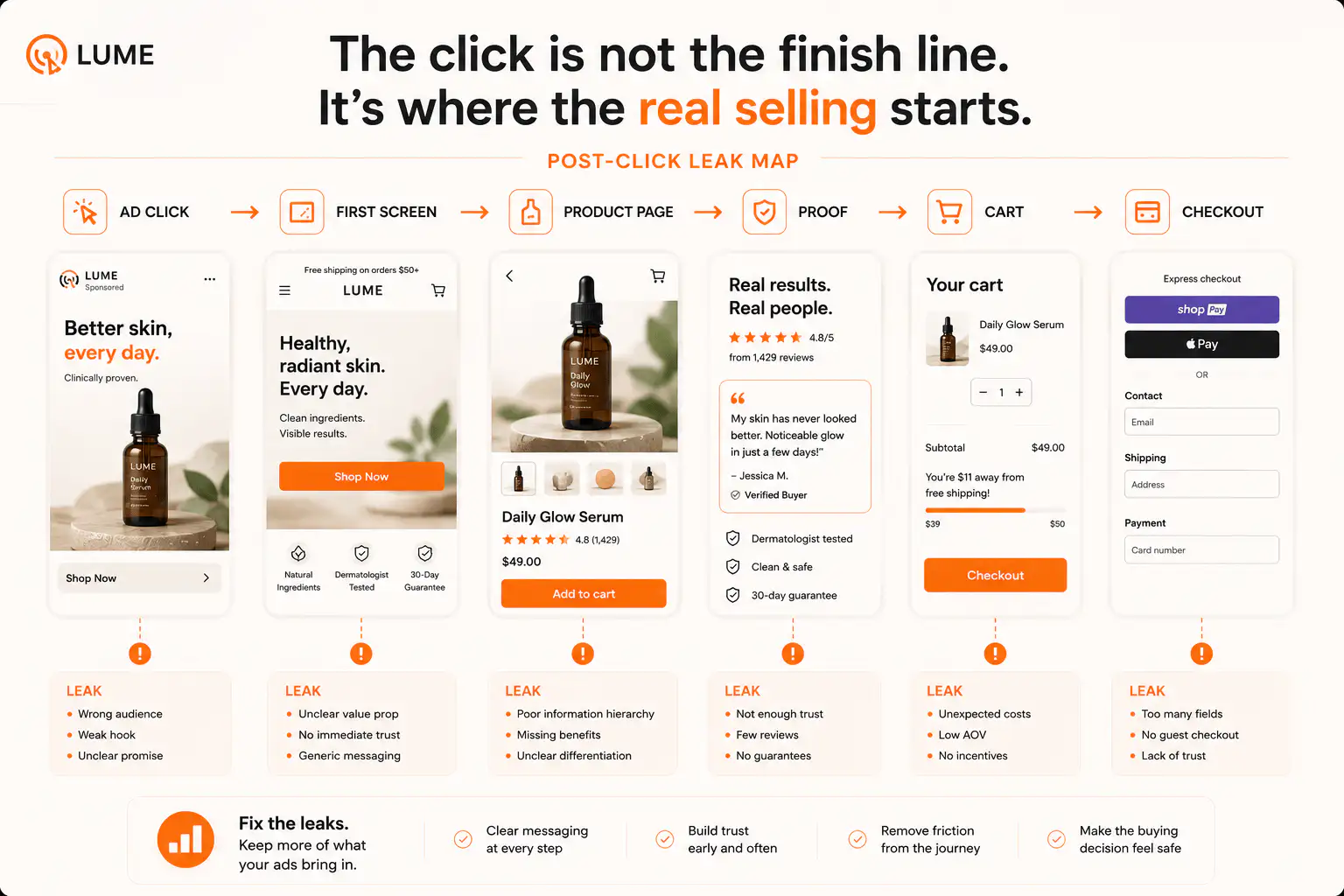
What should you check before changing the TikTok campaign?
First check whether the landing path can convert a cold mobile visitor. The campaign may be weak, but changing targeting or creative first can hide a simpler store problem: the page does not continue the video's promise clearly enough for a shopper to choose.
- Open the TikTok ad on a phone and tap through like a buyer would.
- Confirm the first screen shows the same product, use case, and promise as the video.
- Check whether the product is understandable without watching the video again.
- Look for trust cues before the first CTA: reviews, delivery, returns, guarantee, secure payment, or real product proof.
- Test whether the page loads and responds inside the in-app browser.
- Tap variant selectors, add-to-cart, cart drawer, and checkout on both iOS and Android if possible.
- Compare Shopify sessions, product views, add-to-cart events, and TikTok landing page views before deciding that traffic quality is the only issue.
If sessions are real and add-to-carts are zero, assume the first buying decision is unclear. Prove the path works before trying to scale or retarget.
Does the page continue the TikTok promise?
The most common leak is message discontinuity. The video sells a situation: a travel cutlery set in a lunch bag, a skincare tool in use, a shoe-cleaning result, a phone case surviving a drop, or a bundle that solves a routine. The page lands on a generic product layout that does not replay the reason to care.
A TikTok landing page does not need to look like TikTok. It does need to confirm the same mental frame. If the video showed the product solving a specific moment, the first screen should show that moment or name it directly.
| TikTok promise | Weak landing handoff | Better first-screen confirmation |
|---|---|---|
| Portable product in use | Studio product photo only | Use-case image plus product role and what is included |
| Before/after result | Generic benefit headline | Result visual, proof cue, and realistic timeline |
| Bundle or set | Single product page with no bundle context | Bundle contents, savings, and why the set belongs together |
| Impulse gift | Long brand story first | Gift use case, delivery timing, price, and trust cue |
| Problem solution | Feature list only | Problem language, outcome, proof, and risk reducer |
Is the product clear in the first mobile screen?
TikTok traffic is usually mobile, so the first viewport has to do more work than a desktop PDP. A buyer should be able to answer four questions quickly: what is this, why would I want it, why should I believe it, and what happens if I buy?
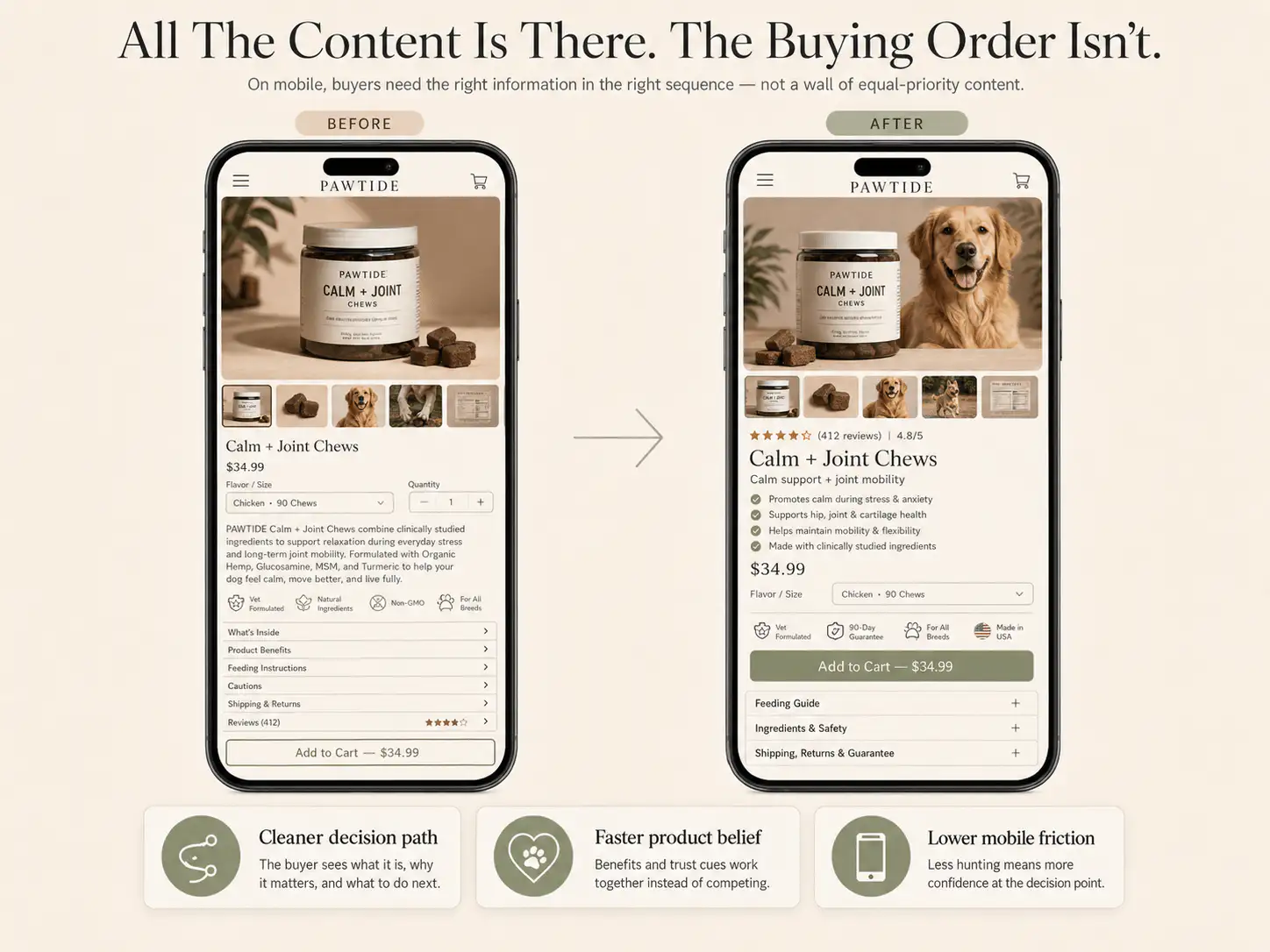
- The first image should identify the product and use case, not only show a polished object.
- The headline should name the product category or problem, not only the brand name.
- The subcopy should explain why this product is different from the cheaper alternative the buyer can imagine.
- Price should have context: what is included, whether it is a set, and whether there is a launch offer.
- Trust should appear before or near the CTA, especially for new stores and cold traffic.
- The CTA should not appear before the buyer understands what choice they are making.
When is this a traffic-quality problem?
Sometimes the store is not broken. TikTok may be sending people who like the video but do not have the buying intent, budget, country fit, or product need. That is still useful to know, but do not jump there until the store path has passed a basic mobile buying test.
| Symptom | Likely diagnosis | Next check |
|---|---|---|
| High clicks, low Shopify sessions | Page load, tracking, in-app browser, or accidental taps | Compare TikTok landing page views with Shopify sessions |
| Sessions but no product views | Homepage or landing page fails to route | Check hero clarity, collection path, and first CTA |
| Product views but no add-to-carts | PDP clarity, proof, price, offer, or variant friction | Review first screen and CTA area |
| Add-to-carts but no checkout starts | Cart cost, shipping, trust, drawer/page friction | Test cart and shipping visibility |
| Checkout starts but no purchases | Payment, delivery, total cost, address, trust, or checkout errors | Run a test order and inspect abandoned checkout details |
If the store receives a lot of visits from countries it does not ship to, from very young audiences, or from a video that attracts entertainment rather than buying intent, the campaign is part of the issue. But that conclusion is stronger after the landing experience is clearly capable of turning qualified visitors into add-to-carts.
Should TikTok traffic land on a PDP, collection, or landing page?
The right destination depends on how much explanation the buyer needs. A single impulse product with a strong video can land on a PDP if that PDP repeats the use case, proof, offer, and risk reducers immediately. A product family, bundle, or high-consideration product usually needs more guided context.
| Product situation | Best starting page | Why |
|---|---|---|
| One simple impulse product | Product page | The buyer can choose quickly if the first screen carries proof and offer context |
| Bundle, kit, or routine | Landing page or bundle PDP | The page must explain what goes together and why |
| Several similar SKUs | Collection or chooser landing page | The buyer needs help choosing before a PDP |
| Product needs demonstration | Landing page with proof sections | The page must replace what the video showed |
| Premium or unfamiliar product | Landing page or long PDP | The buyer needs trust, comparison, and risk reduction before action |
What does TikTok in-app browser friction look like?
A page can pass a desktop review and still fail inside the social app browser. Common issues are slower first load, sticky elements covering the CTA, popups appearing before product context, swipes fighting product galleries, payment wallets not feeling visible, or app scripts delaying the first interaction.
- The first image loads late or jumps after the buyer starts reading.
- A discount popup blocks the product before the buyer understands the offer.
- The sticky add-to-cart bar appears but variants are not selected yet.
- The page relies on hover states, tiny selectors, or desktop-oriented media galleries.
- The add-to-cart drawer opens slowly or looks visually detached from the product.
- The checkout button appears before shipping, delivery, or returns are explained.
What should a TikTok post-click audit include?
Run the audit as a sequence. Do not rewrite the whole store at once. The goal is to find the first place where a curious mobile visitor loses the reason to continue.
- Capture the ad promise in one sentence.
- Open the destination page from TikTok on mobile.
- Check whether the first screen says the same thing the video made the buyer expect.
- Check product clarity: what it is, what is included, how it is used, and who it is for.
- Check proof: reviews, UGC, result evidence, founder proof, certifications, or credible guarantees.
- Check price context: set contents, bundle savings, comparison point, shipping threshold, or return policy.
- Check action: variant state, add-to-cart behavior, cart drawer, checkout handoff, and payment visibility.
- Check analytics: sessions, product views, add-to-cart events, reached checkout, and geographic fit.
Early TikTok traffic can be noisy. Use the first data as a debugging signal, not as a final verdict. If no one adds to cart, fix the obvious first-screen, trust, and mobile path gaps before declaring the product dead.
What should you fix first?
Prioritize fixes that make the first buying decision easier without requiring a full redesign. The fastest useful fixes usually live above the fold, near the CTA, and in the first cart handoff.
| Fix | Use when | Avoid when |
|---|---|---|
| Rewrite first-screen promise | The product is unclear or disconnected from the ad | The issue is a broken cart or unavailable product |
| Add use-case media | The product needs context to feel useful | Existing media already proves the use case clearly |
| Move proof near CTA | Cold visitors do not know whether to trust the store | Proof is irrelevant or unsupported |
| Show shipping and returns early | Buyers may hesitate around risk or timing | Policies are still operationally uncertain |
| Build a TikTok landing page | The product needs explanation before the PDP | A clean PDP already answers the buying questions |
| Change TikTok targeting | The page is strong but visitors are mismatched by country, age, or intent | The landing path has not been tested |
Need the TikTok click path checked?
If TikTok traffic reaches the store but add-to-carts stay near zero, get a Free Buying Journey First-Look. We will review the ad-to-page match, mobile first screen, product proof, cart trigger, and checkout handoff before you keep spending into the same leak.
FAQ
Why do TikTok ads get Shopify traffic but no add-to-carts?
The most common reasons are weak ad-to-page match, unclear product value, missing trust signals, price or shipping hesitation, slow mobile loading, cold traffic quality, or a landing page that does not explain the product fast enough for TikTok visitors.
Is zero add-to-carts from TikTok a checkout problem?
Usually no. If shoppers never add to cart, the first issue is before checkout: the ad promise, landing page, product explanation, proof, offer, variant selection, or mobile page behavior.
Should TikTok ads go to a product page or landing page?
Use a product page when the product is simple and the PDP confirms the TikTok promise immediately. Use a landing page when the product needs explanation, proof, bundles, comparison, or a guided choice before the buyer is ready for the PDP.
What should a Shopify PDP show for TikTok traffic?
Show the same product promise as the video, a clear product image or use-case visual, price context, what is included, proof, shipping or return reassurance, variant clarity, and an obvious CTA on mobile.
When should I change TikTok targeting instead of the store?
Change targeting when the page passes a mobile buying-path test but traffic is mismatched by geography, age, intent, budget, or product need. If the first screen or cart path is unclear, fix that before judging targeting.
Sources and verification notes
- Shopify Community, TikTok ads high traffic with no sales discussion, retrieved 2026-07-18
- Shopify Community, traffic but no conversion to cart or checkout discussion, retrieved 2026-07-18
- Shopify Community, struggling for conversions discussion, retrieved 2026-07-18
- Reddit r/dropshipping, no sales in Shopify discussion, retrieved 2026-07-18
- Reddit r/dropshipping, ad spend with one sale discussion, retrieved 2026-07-18