Why Shopify Product Pages Get Add-to-Carts but No Purchases
Add-to-cart without purchase is usually a confidence leak. Learn how to diagnose whether the problem starts on the PDP, cart, checkout, mobile path, or traffic source.
If a Shopify store gets add-to-carts but few purchases, the buyer is interested enough to continue but not confident enough to pay. The leak may sit on the product page, in the cart, in shipping transparency, in checkout, or in mobile flow.
What does add-to-cart but no purchase mean?
Add-to-cart but no purchase means the product created enough interest for a shopper to continue, but the store did not remove enough risk for them to complete payment. On Shopify stores, this often happens when the product page sells the click but leaves important questions unanswered: what shipping will cost, when the product arrives, whether returns are easy, whether reviews are real, whether the product will fit the buyer's situation, or whether checkout feels safe. The cart then becomes the place where unresolved doubt gets exposed. If many buyers add to cart and reach checkout but do not buy, review the entire buying path instead of only checkout.
Key takeaways
- Add-to-cart without purchase is a confidence leak, not proof that the product page is working.
- Extra costs, slow delivery, trust, forced accounts, and checkout complexity are common abandonment reasons.
- Start diagnosis before checkout because unresolved product-page doubt often shows up later in the cart.
- Fix order matters: offer clarity, cost transparency, trust, delivery, checkout friction, then mobile flow.
An add-to-cart event can look stronger than it really is. Some shoppers use the cart as a price checker. Some add a product to see shipping. Some are comparing total cost against another store. Some are curious from an ad and were never close to purchase.
That means the metric should be treated as a signal, not a conclusion. A rising add-to-cart rate with flat purchases does not automatically mean the product page is good and checkout is bad. It means the page got a micro-commitment, then the journey failed to turn that commitment into confidence.
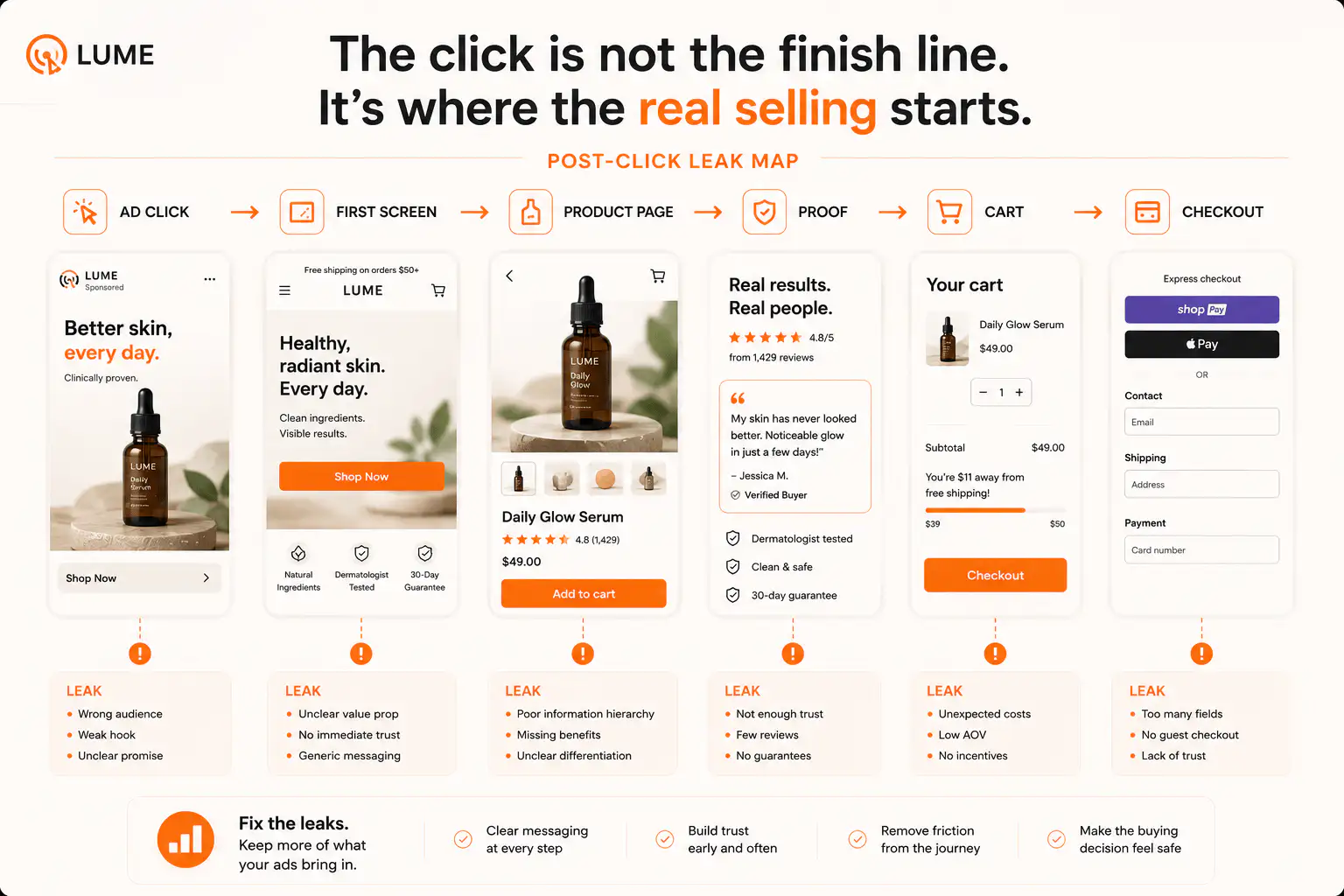
Where does the leak usually appear?
Cart abandonment research from Baymard points to extra costs, slow delivery, trust concerns, forced account creation, checkout complexity, return dissatisfaction, site errors, and unclear total cost as common causes. Those are checkout-stage symptoms, but several should be handled earlier on the product page.
| Leak stage | What the buyer is thinking | What to inspect |
|---|---|---|
| Traffic | Is this what the ad promised? | Ad-to-PDP message match |
| Product page | Do I understand and believe this? | First screen, proof, objections |
| Cart | What will this really cost? | Shipping, tax, discounts, delivery |
| Checkout | Is this safe and easy? | Payment, account, form fields, errors |
| Mobile | This is too much work. | Sticky CTA, variant selection, page order |
What should you check on the product page first?
Start with product-page clarity because it shapes the quality of every add-to-cart. If the page does not answer the buyer's core questions, checkout has to carry the pressure.
- The first image confirms what the product is.
- The headline says the product category and outcome clearly.
- The product promise is specific, not decorative.
- Reviews or proof appear before the buyer has to commit.
- Shipping, returns, guarantee, or delivery timing are visible near the CTA.
- Variant choices are understandable.
- The page explains risk for first-time buyers.
Many Shopify stores put the add-to-cart button above enough belief. The page shows product title, price, variants, and CTA, but not enough proof or risk reversal. That can generate curiosity clicks without creating purchases.
What if shoppers reach checkout and still leave?
If checkout begins but purchases do not happen, inspect cost transparency first. The buyer should not discover the economic truth too late. Shipping, delivery estimates, returns, payment options, and guarantee language should appear before the final payment step.
- Show shipping threshold near the CTA.
- Show delivery estimates before checkout.
- Explain returns before the cart.
- Put payment methods near the buy area.
- If shipping is calculated later, give a realistic range.
- If the product has a high AOV, add stronger guarantee and support cues.
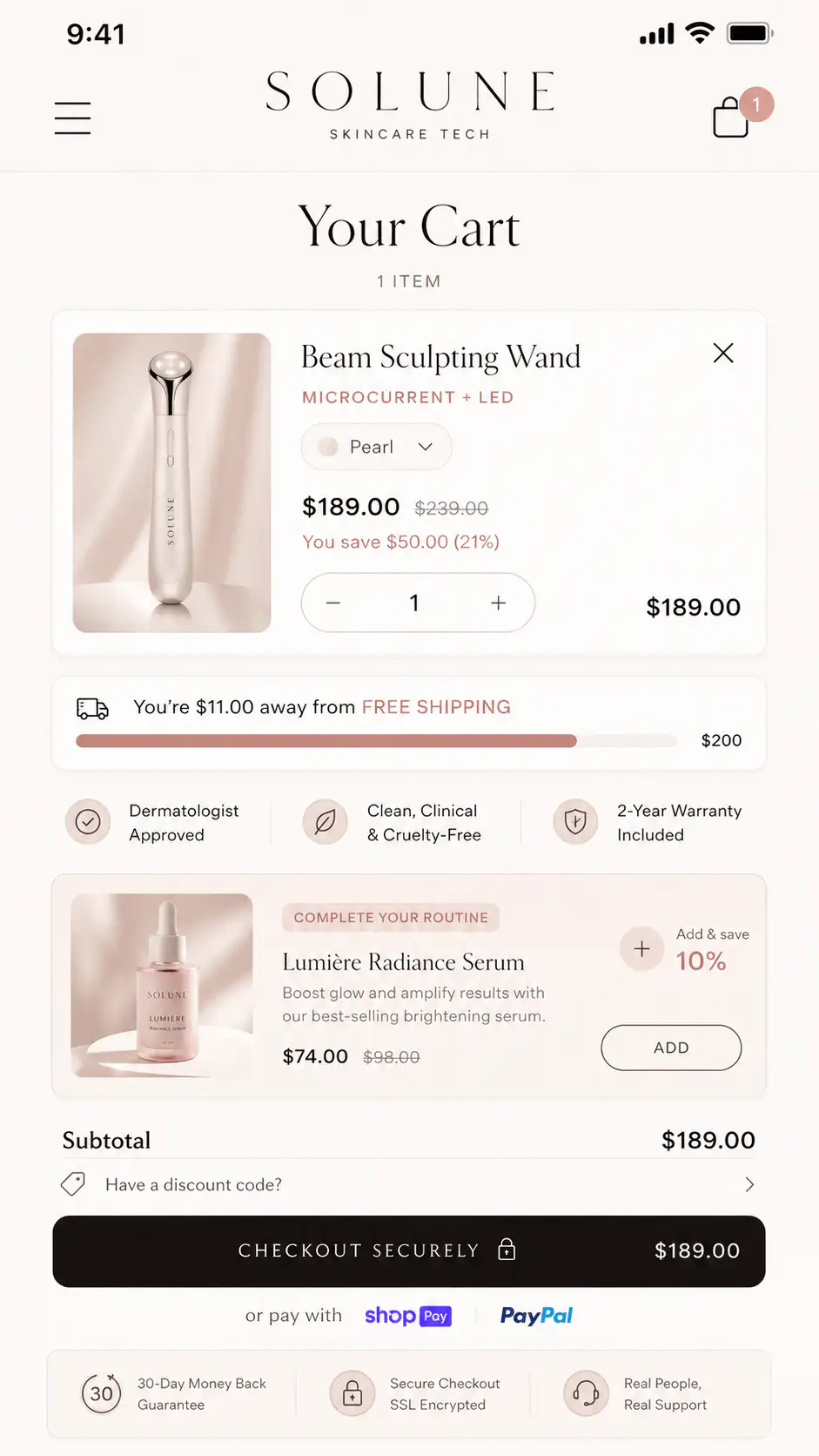
How trust breaks between cart and checkout
Trust is not only about badges. Most trust gaps are more specific: will this product work for someone like me, are these reviews real, what if I choose the wrong size, can I return it, and why should I buy here instead of a marketplace or known brand?
Those questions are not solved by generic payment icons. They are solved by relevant proof near the buyer's doubt: review snippets, customer photos, certification details, return clarity, delivery windows, warranties, and support cues.
How should you prioritize fixes?
| Symptom | Likely first fix |
|---|---|
| High add-to-cart, low checkout start | Cart clarity, shipping, cart drawer UX |
| High checkout start, low purchase | Checkout friction, payment, trust, total cost |
| High PDP views, low add-to-cart | First screen, product clarity, proof, CTA |
| High mobile traffic, low purchase | Mobile order, sticky CTA, page speed, variant UX |
| Paid traffic converts poorly | Ad-to-page match, offer clarity, landing path |
Want a quick read on your leak path?
If buyers are adding to cart but not purchasing, the leak may not be where Shopify reports the drop-off. Send your store URL and get a Free First-Look at the product page, cart, and checkout path.
FAQ
Is add-to-cart but no purchase always a checkout problem?
No. Checkout can be the visible drop-off, but the real issue may start on the product page. Buyers often add to cart before they have enough confidence, then abandon when shipping, delivery, trust, or total cost becomes real.
Should I offer free shipping to fix cart abandonment?
Not always. Free shipping can help, but the deeper principle is cost transparency. If shipping is not free, show clear thresholds, ranges, or delivery expectations before checkout so buyers do not feel surprised.
Do trust badges fix add-to-cart but no sales?
Only if payment trust is the actual bottleneck. Many stores need specific proof instead: customer photos, review snippets, return clarity, guarantee, delivery details, or product-fit guidance near the CTA.